




Age-Friendly Shower Hardware Procurement Guide: How to Specify a Seated Shower System
Population ageing and the rising number of bathroom falls are turning "age-friendly renovation" from a policy phrase into an actual purchase order list for senior care operators, residential remodelling contractors and distributors.
Between 1974 and 2024, the worldwide share of people aged 65 and above rose from 5.5% to 10.3%. According to United Nations population projections, this figure will double again to 20.7% by 2074 (source: UNFPA, June 2024).
U.S. CDC data is more direct: more than 14 million adults aged 65 and older report falling each year, and about 37% of those who fall report an injury that required medical treatment or restricted their activity for at least one day. The age-adjusted fall death rate increased by 21% between 2018 and 2024, from 64.7 to 78.4 per 100,000 older adults.
Bathrooms are among the most common locations for falls, and the highest-risk moments are entering or leaving the shower area and the sit-to-stand movement.
This translates directly into procurement demand. Senior care facilities, residential remodelling contractors, healthcare real estate developers and distributors across North America and Western Europe are looking for complete age-friendly shower hardware packages rather than scattered individual parts.
An age-friendly shower has to solve three problems at once: fall support, standing fatigue and operating difficulty. Adding grab bars alone only solves the first one.
| Step | Standing Shower | Seated Shower |
|---|---|---|
| 1 | Hold the wall-mounted grab bar to enter | Hold the wall-mounted grab bar to enter |
| 2 | Remain standing throughout (high risk of standing fatigue and slipping) | Sit down safely (no prolonged standing, lower chance of slipping) |
| 3 | Adjust the shower head height | Adjust the shower head height |
| 4 | Hold the grab bar to exit | Hold the grab bar to stand up and exit |
Adding wall-mounted grab bars inside the enclosure only gives the user something to hold on to. It does not solve the fact that older adults cannot stand for long. Seated showering reduces the dependence on standing balance at its root, and it also lowers the physical load on caregivers.
- Safety support: prevent falls and withstand body weight plus the impact force generated at the moment of losing balance
- Seated assistance: reduce standing time and lower the risk of fatigue-related accidents
- Ease of operation: reduce the need to bend over and lower the chance of losing grip with wet hands
Among these, safety support is the core layer. Whether standing or seated, users need continuous or intermittent support throughout the entire showering process.
A complete age-friendly shower system is built from three hardware categories, each serving a different function:
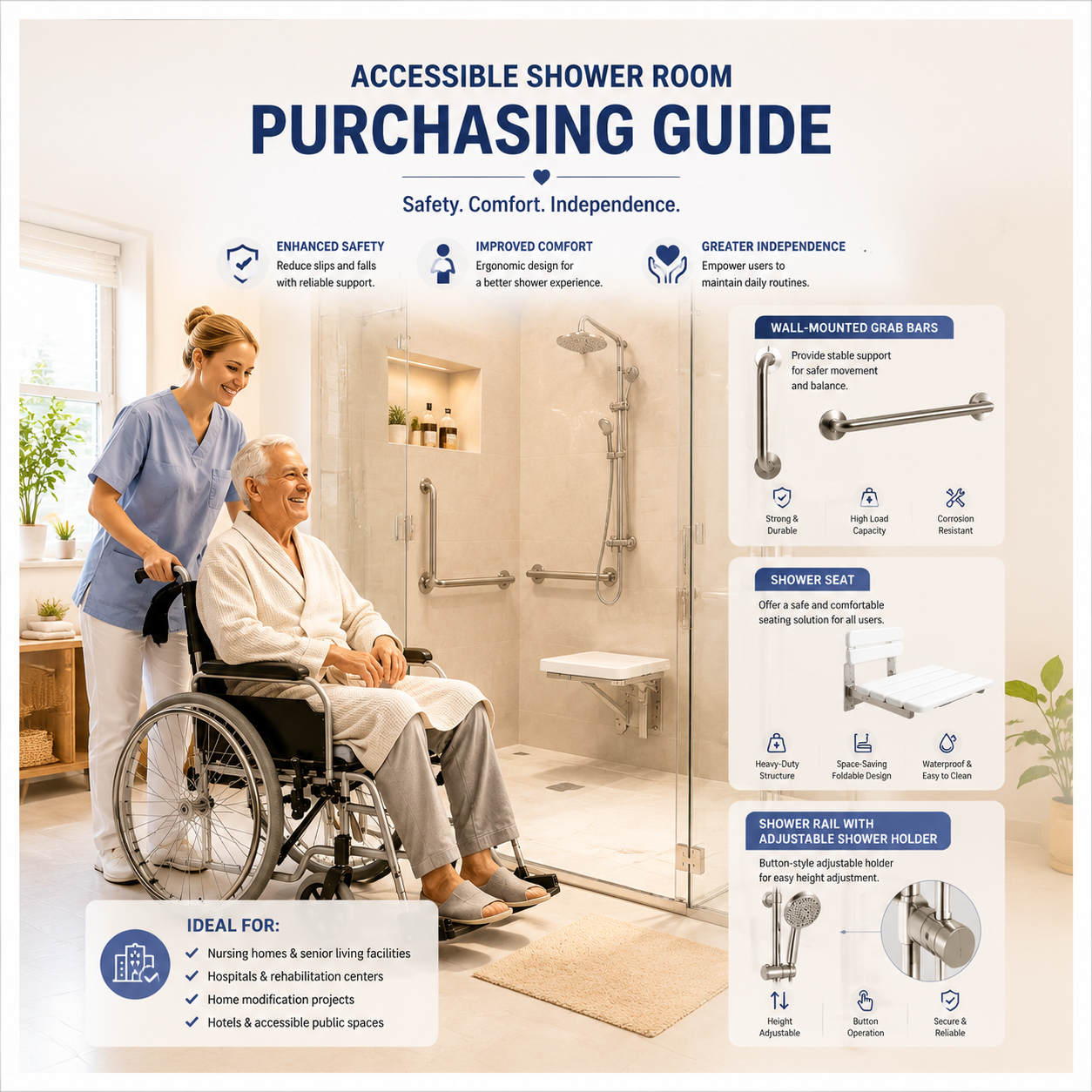
The sections below break down the procurement considerations for each of these three categories.
The wall-mounted grab bar is the most critical safety component in an age-friendly shower. It must be anchored into a load-bearing wall or structural framing, and there are four things to check when sourcing.
Ask the supplier for an independent third-party test report rather than relying on a stated rating. The force applied to a grab bar at the moment an older adult loses balance is far greater than normal pulling force, so a larger safety margin is always better.
Reference benchmark: ADA 609.8 requires that allowable stresses are not exceeded when a vertical or horizontal force of 250 pounds (1112 N) is applied at any point on the grab bar, fastener, mounting device or supporting structure.
- Wall clearance: requirements differ by market, and across the three major standards the range falls between 38–60mm. ADA 609.3 requires exactly 38mm, while European and Australian standards call for larger clearances.
- Gripping diameter: ADA 609.2.1 requires an outside diameter of 32–51mm for circular cross sections. From an older user's grip comfort perspective, 32–40mm offers the best balance between comfort and secure hold.
The most common configuration uses two bars:
- One on the wall beside the shower seat: assists sitting down and standing up
- One near the shower entrance: assists entering and leaving the shower area
These two bars cover completely different safety movements and cannot replace each other. Some markets also require vertical grab bars, so confirm the accessibility design regulations of your target market before ordering.
For long-term use in wet areas, 304 stainless steel offers a reasonable balance between corrosion resistance and cost. Coastal and high-humidity projects need extra attention to surface treatment to avoid yellowing or coating delamination after installation. For how to select the right finish, see Shower Accessories Factory Wholesale Guide: Choosing the Best Surface Treatment.
Reference model: Shower Grab Bar LS-2039 — 304 stainless steel shower safety bar, 700mm hole distance, polished finish, wall-mounted, suitable for age-friendly bathrooms, accessible washrooms and commercial showers. MOQ 100.
The shower seat is the core component of a seated shower system, and selection comes down to four dimensions.
- Senior care and healthcare projects: choose products rated at 250kg or above to leave sufficient safety margin for unexpected situations
- Standard residential renovation: the 150–200kg range is generally sufficient
Note that a stated max capacity is a static load figure and is not the same as passing a dynamic test under a specific standard. For project tenders, request the test report alongside the spec sheet.
The universally comfortable range is 430–480mm, close to standard chair height. ADA 610.3 specifies that the top of a shower compartment seat shall be 17–19 inches (430–485mm) above the finish floor. Within that range, the height can be fine-tuned to the average height of the intended users.
- Wall-mounted folding: takes up the least space and folds away when not in use; requires wall drilling and adequate structural support behind the wall
- Freestanding (no drilling): does not rely on the wall for load bearing and is the easiest to install, suitable for rental properties, temporary modifications or situations where the wall cannot be drilled; choose products with anti-slip feet to prevent movement during use
| Material | Advantages | Points to Note |
|---|---|---|
| PU anti-slip | Warm to the touch, slip resistant, best overall user experience | Surface damage is difficult to repair locally |
| Teak wood | Naturally water resistant, premium appearance | Higher unit cost, requires periodic maintenance |
| Acrylic | Easy to clean, stain resistant | Firmer seating feel, cold to the touch in winter |
The Hydrorelax Shower Seats range offers several specifications:
- ZD-801 — ADA Compliant, with backrest and arms, zinc alloy frame with PU seat board, 30×30×17cm, rated 150kg (suited to residential renovation projects)
- ZD-802 — wall-mounted folding, 304 stainless steel frame with PU anti-slip seat pad, seat 41×36.5cm, rated 300kg
- ZD-805 — freestanding, no drilling required, non-waterlogging anti-slip design, 304 stainless steel frame with PU anti-slip seat pad, 44.5×27.5×42.5cm, rated 300kg (suited to rental housing and projects where walls cannot be drilled)
Selection note: by load capacity, ZD-801 (150kg) fits residential renovation while ZD-802 and ZD-805 (both 300kg) fit senior care and healthcare projects. By mounting method, ZD-801 and ZD-802 are wall-mounted folding types requiring drilling, while ZD-805 is freestanding and requires no drilling.
In a seated position, a shower head mounted at standard height cannot reach the user's head. Adding a shower rail is one of the most cost-effective age-friendly upgrades available — but a rail and a grab bar are two different products.
- Stainless steel: the best balance between performance and cost, and the mainstream choice for project procurement
- Copper alloy (solid brass): more premium appearance, suited to high-end positioning
- Aluminium alloy: lighter in weight with good corrosion resistance
- Drilled surface mounting: the mainstream option, offering stronger stability and durability
- No-drill adhesive mounting: easier to install, suitable for rentals, temporary modifications or walls that cannot be drilled
Within the Hydrorelax Shower Risers range, SJG07 uses a 430 stainless steel rod with an ABS base and supports both screw-fixed and adhesive installation, which suits rental and retrofit projects where drilling is restricted.
For rail compatibility, installation and long-term maintenance, see Shower Riser Procurement Guide and Application Issue Solution and Shower Riser Selection, Installation and Maintenance Guide for B2B Buyers.
This is the single most important point in this guide.
A rail and a grab bar can look similar, but their structural design is completely different: a shower rail is engineered only for the vertical sliding movement of the shower head and is not designed to withstand horizontal pulling force from a human body.
An age-friendly shower must ensure that:
- A separately installed, dedicated grab bar is positioned next to the shower rail
- The rail position does not obstruct the gripping space on the grab bar
The same applies to the glass support bar in a shower enclosure, which is a structural component rather than a body-support component. For the functional differences, see Shower Support Bars: Types, Functions, and B2B Selection Guide.
The holder itself carries no body load, but it determines whether an older user can position the shower head with one hand.
There are four main material categories: ABS engineering plastic, copper alloy, stainless steel and aluminium alloy.
Among them, ABS engineering plastic is the most commonly used for handheld shower holders. Older adults often have reduced hand strength, and ABS is lighter and easier to operate while performing reliably against corrosion in wet areas. For a full comparison of materials and specifications, see The Complete B2B Guide to Hand Shower Holder.
| Mechanism | Operating Characteristics | Age-Friendliness |
|---|---|---|
| Lever-style | Loosen, reposition, then retighten | Low (needs both hands) |
| Rotary knob | Requires twisting force and wrist flexibility | Medium |
| Push-button | Press to unlock, release to auto-lock, one-hand operation | High |
Because older users have reduced hand flexibility and grip strength, push-button adjustment is clearly better than the other two types.
Within the Hydrorelax Hand Shower Holders range, HT02 is an ABS horizontal push-button holder, listed as Elderly Friendly, supporting one-hand operation and multi-angle adjustment.
Accessibility requirements differ between markets, so confirm your target market before fixing specifications.
| Item | U.S. ADA (2010 Standards) | Australia AS 1428.1:2021 | Europe EN ISO 21856:2022 / UK BS 8300-2:2018 |
|---|---|---|---|
| Grab bar load capacity | 250 lbs (1112 N) (609.8) | 1100 N, with no permanent distortion | Static load 1500 N |
| Gripping diameter | 32–51mm (609.2.1) | 30–40mm | — |
| Grab bar wall clearance | Exactly 38mm (609.3) | 50–60mm | ≥45mm |
| Shower seat height | 430–485mm (610.3) | 470–480mm | — |
| Shower head reachable height | ≤1220mm (608.5, maximum mounting height for controls and spray unit) | — | 750–1000mm (UK Approved Document M) |
| Installation tolerance | — | ±10mm (added in the 2021 edition) | — |
| Seat material requirements | — | — | REACH / RoHS compliance (added in EN ISO 21856:2022) |
A shower holder has few anchoring points and thin screws, and is designed to carry only the weight of a shower head (usually no more than 0.5kg). It does not have the structural strength to support body weight. Using it as a support point creates a safety hazard and can lead to liability disputes after an accident.
The fixing depth and structural design of a shower rail are not intended for body support, so it cannot replace a dedicated grab bar that has been independently tested and certified. The same applies to shower door pull handles and glass support bars.
If the seat is installed too low, older adults need greater leg force to move from sitting to standing, which increases fall risk instead of reducing it. ADA requires a seat height of 17–19 inches (430–485mm), close to standard chair height and suitable for the large majority of older users.
Chrome gloss levels and matte textures vary between suppliers, and the installed result often shows a visible mismatch. Source all related hardware from a single supplier, or request finish samples for comparison at the quotation stage. For other details that are easy to overlook in bulk orders, see Bulk Buying Shower Hardware: 5 Details You Can Not Miss.
- The grab bar is the only component that must be anchored into the wall structure — request a third-party test report, do not accept a verbal rating, and do not accept a no-drill solution
- Pull handles, shower rails and glass support bars are not grab bars — a similar appearance does not mean a similar structural design
- Seat height determines standing-up safety — 430–485mm is the universal safe range, and going lower increases risk
- When walls cannot be drilled, specify a freestanding seat — it does not rely on the wall for load bearing; check the rated capacity and the anti-slip feet
- Fix the target market before fixing the specification — ADA, AS 1428.1 and EN ISO 21856 require different wall clearances and diameters
- Same batch, same supplier — avoids on-site rework caused by mismatched finishes
Age-friendly shower renovation projects usually need several hardware categories at once — grab bars, seats, rails and holders. Sourcing them separately easily leads to dimensional mismatches, inconsistent finishes and misaligned delivery schedules.
Hydrorelax supplies complete shower hardware packages for senior care facilities, residential remodelling contractors and distributors, with OEM / ODM customisation, product samples and technical specification documents available. For how to assess a shower hardware supplier, see 5 Things to Check When Choosing a Shower Enclosure Hardware Supplier.
If you are sourcing a systematic solution for a senior care facility, a residential renovation or a construction project, contact us for one-to-one support from our engineering consultants.
Get grab bars, shower seats, rails and holders from one supplier — matched finishes, aligned lead times, OEM / ODM support.
Get in Touch